Advanced Roof Valley Protection Materials for Preventing Premature Deterioration in Complex Roof Designs
Roof valleys fail before the rest of the roof because they carry far more water than any other part of the roof surface. Where two slopes meet, every litre of rain that lands on both planes funnels into one narrow channel, and that concentrated flow wears out shingles, underlayment and flashing years ahead of the field of the roof. Advanced valley protection materials — heavy-gauge metal flashing, self-adhering membranes and purpose-built valley profiles — spread that load and keep the channel watertight long after ordinary roofing would have given up.
Complex roof designs make the problem worse. Dormers, additions, intersecting gables and changes in pitch all create valleys, and each one is a place where water, snow, leaves and ice collect. A valley that is protected with the right materials and installed with care can last as long as the roof itself. A valley that is skimped on becomes the first leak in the house, usually showing up as a stain on a ceiling or damp insulation in the attic, long after the damage has started.
How Valley Water Loads Turn Small Defects Into Major Leaks
A valley does not just receive the rain that falls on it directly. It collects the runoff from both adjoining roof planes, which means the volume of water moving through the channel can be several times greater than the rainfall on any equal area of the open roof. That water moves fast, it carries grit and debris, and it finds every nail hole, every lifted shingle edge and every gap in the flashing. A defect that would be harmless on a flat stretch of roof becomes a leak in a valley within a season or two.
Winter adds a second load. Valleys are the first places where snow builds up and the last places where it melts, so freeze-thaw cycles work the materials harder there than anywhere else. Ice dams form in valleys more readily than on open slopes, and when meltwater backs up behind the ice it can travel sideways under the shingles. This is why valley protection is not a single product but a system: a membrane that seals around fasteners, a metal channel that carries the water, and a surface layer that sheds debris.
Which Valley Style Suits Your Roof and Climate?
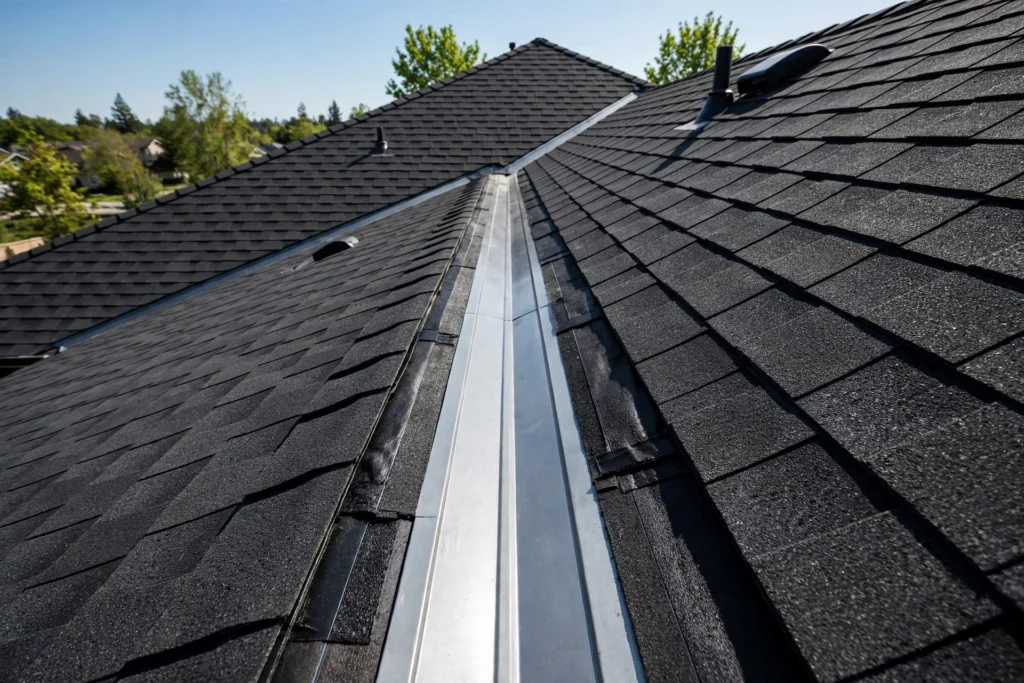
The valley style you choose decides which protection materials make sense. An open valley leaves a strip of metal flashing visible down the centre, and it is the most forgiving design in heavy rain and snow country because the water runs on metal rather than on shingles. A closed-cut valley hides the metal under overlapping shingles for a cleaner look, but it depends entirely on the membrane beneath, because the shingles themselves are cut and sealed along the waterline.
| Valley Style | How Water Is Carried | Best Climate | Main Weakness |
|---|---|---|---|
| Open valley | Exposed metal channel | Heavy rain, snow, debris | Metal visible; needs correct width |
| Closed-cut valley | Shingles overlap; membrane below | Moderate rain, clean look wanted | Cut edges can lift and admit water |
| Woven valley | Shingles interlaced across centre | Mild climates, three-tab shingles | Traps debris; uneven surface slows flow |
| W-valley profile | Raised centre rib splits flow | Complex roofs, high-volume runoff | Needs precise fitting at intersections |
For complex roofs with several intersecting planes, open valleys and W-valley profiles are usually the safer choice, because they keep the water on a smooth, inspectable surface. Woven valleys look tidy but trap leaves and slow the flow, which is the opposite of what a busy valley needs. Whatever style you choose, the membrane underneath matters more than the visible finish, so never let a contractor skip it.
Metal Flashing Materials That Carry Valley Water Safely
Metal is the workhorse of valley protection, and the choice of metal decides how long the valley lasts. Copper is the premium option: it resists corrosion, handles foot traffic during maintenance, and can outlast the shingles by decades, but it costs several times more than steel. Galvanised steel is the common mid-range choice, strong and affordable, though its zinc coating eventually wears and it needs to stay dry on its underside. Aluminium is light and naturally corrosion-resistant, but it dents easily and can be damaged by anyone walking the valley.
Thickness matters as much as the metal itself. Valley flashing should be at least 26-gauge for steel or the equivalent in aluminium, and wider is better: a 24-inch-wide valley metal gives water room to spread and keeps the flow away from the shingle edges. In coastal or high-pollution areas, step up to copper or stainless steel, because salt and industrial fallout attack galvanised coatings far faster than inland weather does. Whatever metal you choose, it must run continuously from the ridge to the eave with no joints in the middle of the run.
Gauge and width are worth discussing with your roofer before the order goes in, because the cheapest valley metal on the shelf is often the thinnest, and thin metal dents underfoot, oil-cans in the sun and corrodes sooner. Ask for the gauge in writing on the quote, and check the delivered material against it: a simple magnet test separates steel from aluminium, and a thickness gauge costs very little. A valley that is only a few millimetres wider than the minimum also buys real margin, because it keeps the water channel clear of the shingle edges even when debris narrows the flow during a storm.
Peel-and-Stick Membranes: The Hidden Layer That Saves Valleys
Under the metal or the shingles, a self-adhering membrane is the layer that turns a valley from vulnerable to watertight. Peel-and-stick modified bitumen, sold as ice and water shield, bonds directly to the roof deck and seals around every nail that passes through it, so even if the surface layer is damaged, water cannot reach the timber below. It is the single most important upgrade in modern valley protection, and it is cheap compared with the cost of repairing a leak.
- Full coverage: run the membrane the entire length of the valley and at least 18 inches up each adjoining slope, not just a narrow strip down the centre.
- Seal the laps: overlap membrane courses by the manufacturer’s recommended amount and roll them firmly so no air pockets remain.
- Protect the deck first: apply the membrane to clean, dry decking before any metal or shingle goes on, so the bond is complete.
- Mind the temperature: install in mild weather when the adhesive can bond properly, and never lay it over wet or dusty timber.
- Layer under everything: the membrane goes under the metal flashing and under the shingles, so it is the last line of defence, not the first.
A valley with a properly installed membrane can survive a surprising amount of surface damage without leaking, which is exactly why it is worth the extra material and labour. The membrane is also the reason closed-cut valleys can work at all: the visible shingles are only the first defence, and the membrane is what actually keeps the house dry when a cut edge lifts or a sealant line dries out.
W-Valley Profiles and Dead Valleys in Complex Roof Designs
A W-valley profile adds a raised rib down the centre of the metal channel, and that rib stops water from washing across the valley and under the shingles on the far side. On complex roofs, where valleys meet at odd angles and water arrives from several directions at once, that rib is the difference between a channel that drains and one that overflows. W-valley metal is formed to order for the roof, so it costs more than flat valley metal, but on a busy intersection it earns its price many times over.
Dead valleys are the opposite problem: a flat or nearly flat area where a roof plane meets a wall, a chimney or a dormer, and water simply cannot drain. Standing water in a dead valley rots decking and breeds mould, and no amount of sealant will fix it permanently. The real cure is to rebuild the geometry, usually with a cricket — a small peaked structure that splits the water and sends it into two properly draining valleys. Where rebuilding is not possible, the fallback is heavy membrane coverage, continuous metal flashing and step flashing at every course, checked twice a year.
Installation Details That Decide Whether Valley Protection Holds
Valley protection fails most often at the details, not the materials. Nails must stay at least 15 cm from the valley centreline, because every nail near the channel is a hole in the water path. Shingles must be cut in a straight line a consistent distance from the centre, and the cut edges bedded in roofing cement so wind cannot lift them. Metal laps must face downhill, so water flows over the joint rather than into it, and every lap needs sealant as well as fasteners.
At the eave, the valley metal should extend past the fascia and drip into the gutter, not stop short and let water run down the fascia board. At the ridge, the two valleys should meet cleanly with no gap for wind-driven rain to enter. These are small points, but they are exactly the points that separate a valley that lasts thirty years from one that leaks in five. If you are hiring the work, ask the roofer to walk you through each of these details before the first shingle is laid.
It also helps to agree the inspection points in advance, so the work can be checked while the valley is still open. Ask to see the membrane coverage before the metal goes on, and the metal laps before the shingles cover them, and take photographs at each stage. A roofer who welcomes that kind of checking is usually a roofer who does the details properly, and the photographs become a useful record if a leak ever appears later and you need to show what was installed.
Keeping Valleys Clear: Inspection and Maintenance Rhythms
Even the best valley materials need cleaning. Leaves, twigs and granules washed off the shingles collect in the channel and form a dam, and a dammed valley holds water against the shingles until it finds a way in. Clearing the valley twice a year — once after the leaves fall and once after winter — is the cheapest maintenance a roof can get, and it takes less than an hour with a soft brush and a hose.
| Inspection Task | When to Do It | What to Look For |
|---|---|---|
| Clear debris from the channel | Spring and autumn | Leaves, twigs, granule build-up forming dams |
| Check metal for rust or dents | Every autumn | Orange staining, pitting, lifted edges |
| Look for lifted shingle edges | After high winds | Curled or missing shingle corners near the valley |
| Check for ice dam signs | Late winter | Icicles at the eave, damp spots in the attic |
| Confirm gutter flow | After clearing | Water backing up where the valley meets the gutter |
Never walk directly in a valley if you can avoid it, and never use a pressure washer on it: both can dent the metal or drive water under the shingles. Work from a ladder or from the roof edge, and use a soft brush. If you spot rust, lifted edges or a soft spot in the decking, call a roofer rather than patching it yourself, because valley repairs done badly usually make the leak worse.
Valley Protection FAQs for Complex Residential Roof Designs
How long should valley flashing last on a residential roof?
Good valley metal lasts 25 to 50 years depending on the material: galvanised steel around 25 years, aluminium around 20 years, and copper 50 years or more. The membrane underneath usually outlasts the shingles, so the valley often survives several re-roofs if the metal is sound.
Can I use the same shingles in the valley as on the rest of the roof?
Yes, but the valley needs extra protection beneath them. In a closed or woven valley the shingles are the visible layer only; the waterproofing comes from the peel-and-stick membrane and any metal underneath. Never rely on shingles alone in a valley.
Why does my valley leak even though the shingles look fine?
Because the leak usually starts underneath. A failed membrane, a nail too close to the centreline, or a corroded section of metal can all admit water while the surface looks perfect. The water then travels along the deck and appears as a stain some distance from the actual entry point.
Is an open valley better than a closed valley?
In heavy rain and snow, yes. Open valleys carry water on exposed metal, shed debris easily, and are simple to inspect. Closed valleys look cleaner and suit milder climates, but they hide the waterproofing layer and depend entirely on the membrane when a cut edge lifts.
How often should roof valleys be inspected?
At least twice a year, in spring and autumn, plus after any major storm. Look for debris dams, rust, lifted shingle edges and signs of water staining in the attic below the valley. Catching a problem early is the difference between a cleaning and a rebuild.
Final Thoughts: Protect the Valley and the Whole Roof Lasts Longer
A roof is only as strong as its valleys, and valleys are where complex roofs earn their reputation for leaks. Choose the valley style that fits your climate, put a self-adhering membrane under everything, use metal thick enough to last, and keep the channel clear. Do those four things, and the busiest part of your roof will quietly do its job for decades instead of becoming the first expensive repair on the house.