Concrete Repair vs Replacement: What’s the Best Option for Australian Infrastructure?
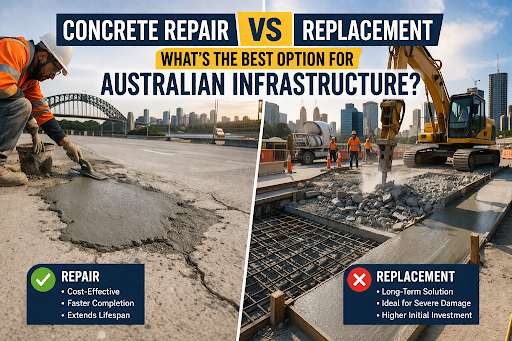
When you’re driving across a regional bridge in New South Wales or walking through a bustling CBD in Melbourne, you probably don’t think much about the concrete beneath you. But for those of us tasked with managing these assets in 2026, that “solid” ground is part of a massive conversation about sustainability and tightening budgets.
Australia’s infrastructure is currently hitting a critical age. Much of our post-war “big build” is showing its grey hairs, and the dilemma is always the same: do we patch it up or rip it all out? In the showdown of concrete repair vs replacement, the “right” choice is no longer just about cost; it’s about the planet and the long-term lifecycle of the asset.
The Repair Route: Giving Concrete a Second Life
In 2026, “circular economy” isn’t just a buzzword; it’s the standard for Australian civil works. Concrete maintenance solutions by Civilcraft have advanced to the point where we can often save structures that, ten years ago, would have been destined for the landfill.
When Repair Wins:
- Budget Constraints: Generally, repair costs roughly $60 – $150 per square metre, whereas a full-depth replacement can easily double that when you factor in demolition and disposal.
- Minor Spalling and Cracks: If the damage is superficial or caused by localised issues like “concrete cancer” (reinforcement corrosion) that hasn’t compromised the core, targeted remediation is a winner.
- Sustainability Targets: Repairing concrete has a significantly lower carbon footprint than pouring new slabs. Since Australia is pushing hard for Net Zero, choosing high-tech mortars and cathodic protection over demolition scores major “green” points.
The Replacement Route: Starting Fresh
Sometimes, no amount of TLC can save a slab. If the structural integrity is compromised, pouring money into repairs is like putting a Band-Aid on a broken leg.
When Replacement Wins:
- Deep Structural Failure: If the subgrade has settled or the cracks are “moving,” repairs will just fail again in six months.
- Cost Over Time: If you find yourself repairing the same section every two years, the “cheap” fix becomes the most expensive option. Replacement offers a fresh 50-to-100-year service life.
- Asset Repurposing: If a road or bridge needs to carry heavier loads than it was originally designed for, replacement allows us to use modern, high-strength mixes like Geopolymer or low-carbon concrete.
Comparison: Concrete Repair vs. Replacement
| Factor | Concrete Repair | Full Replacement |
| Average Cost (2026) | $60 – $150 per m² | $150 – $300+ per m² |
| Environmental Impact | Low (Reuses existing material) | High (New cement production) |
| Disruption Time | Short (Hours to days) | Long (Weeks of curing) |
| Service Life Extension | 10 – 25 years | 50 – 100 years |
| Best For | Surface wear, minor corrosion | Deep cracks and structural failure |
The “Smart” Middle Ground: Maintenance
The best way to avoid the concrete repair vs replacement headache altogether? Concrete maintenance solutions. By using digital twin technology and IoT sensors, we can now predict when a bridge needs a “seal” before it ever needs a “repair.”
Proactive measures, like applying deep-penetrating hydrophobic coatings, using AI-powered drones for early crack detection, and implementing self-healing crystalline sealants, can push back a total replacement by decades. In 2026, staying ahead of the curve doesn’t just save your budget; it’s the most sustainable way to manage Australia’s heavy-use assets.
Final Thoughts
Concrete repair vs replacement: Which way are you leaning for your next project? If your concrete is just looking a bit “tired” but the bones are good, repair is your best friend. But if you’re seeing wide, deep cracks and shifting levels, it might be time to call in the demo crew.
FAQs
Is concrete repair always cheaper?
In the short term, yes. However, if the underlying soil is the problem, repair is a temporary fix that will cost more in the long run than a proper replacement.
What is “Concrete Cancer”?
It’s when the steel rebar inside the concrete rusts and expands, causing the concrete to flake off (spall). If caught early, it can be repaired; if left too long, replacement is inevitable.
Does replacement take a long time?
Yes. While “rapid-set” mixes exist, a standard infrastructure-grade slab often needs 28 days to reach full strength, causing significant traffic or pedestrian delays.
Are there green options for replacement?
Absolutely. In 2026, many Australian councils specify low-carbon concrete or recycled aggregate mixes to offset the environmental cost of new pours.
Can I repair cracks myself?
For a garden path? Sure. For a structural driveway or public asset? No. Professional concrete maintenance solutions involve pressure-injecting resins that require specialised gear.
Stay in touch to get more updates & news on Lufa Nest!